


Ylang-Ylang
Ylang-Ylang means "flower of flowers" in the Philippines.
A coveted material for perfumers, it is also highly appreciated by local populations in the Indian Ocean. In Indonesia, ylang-ylang flowers are spread on the bed of newlyweds.
Associated with the second chakra, the Ylang-Ylang fragrance relaxes and gives a feeling of security.
-

HARMONIZING
The essential oil of Ylang-Ylang helps with meditation. It allows you to relax while staying aware of your emotions and psyche.
-
HEART NOTE
The heart notes give the perfume its deep identity. Mostly composed of floral notes, it develops between 15 minutes and 4 hours.
-
PURE
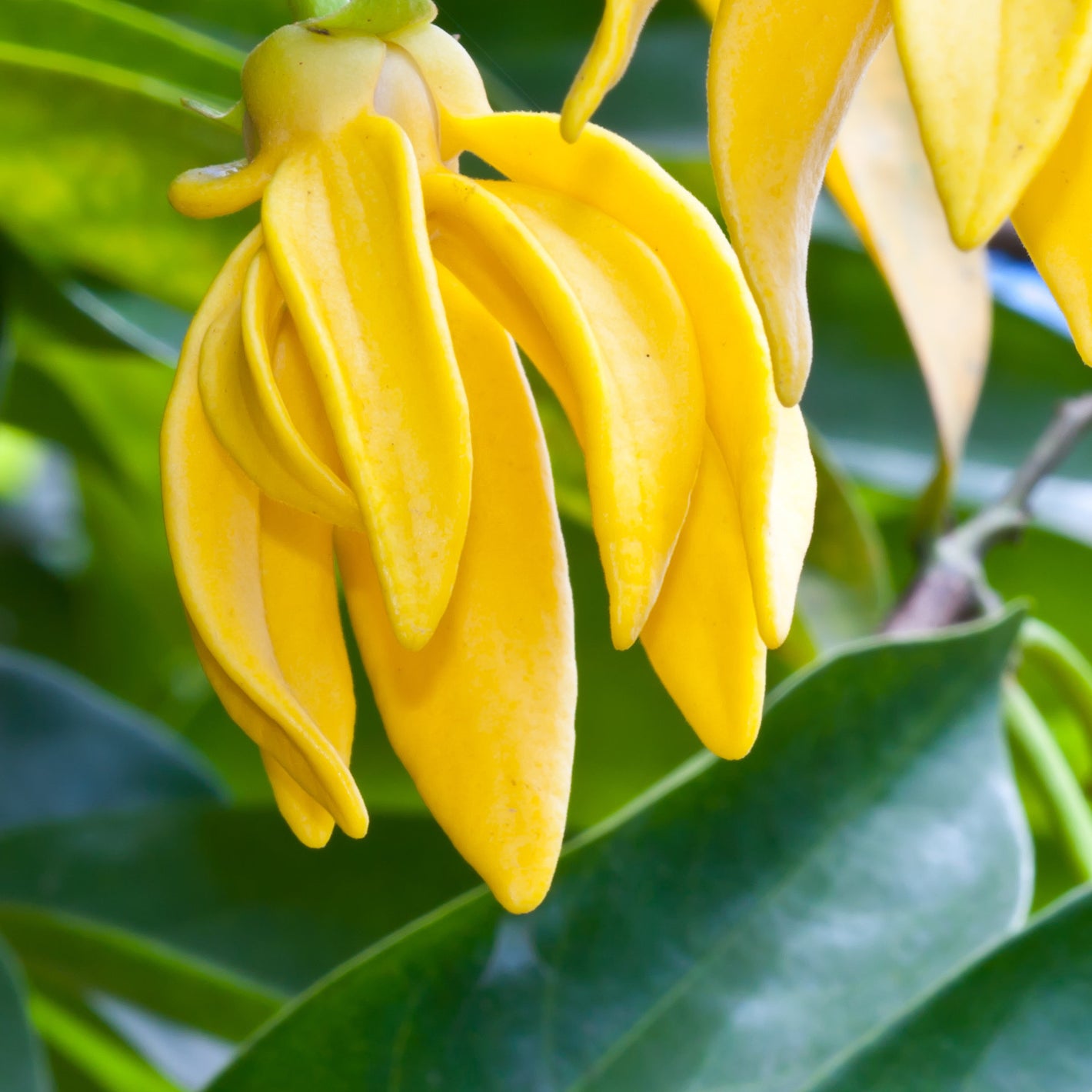
The distillation of Ylang-Ylang is long. The essence obtained during the first hour is the purest and most prized by perfumers for its exceptional quality.

Rich in monoterpene esters, a perfume with Ylang-Ylang has a relaxing effect.
More precisely, Ylang-Ylang essential oil has antispasmodic properties.
Its strong and exotic scent is also well known for its aphrodisiac effects.
Finally, Ylang-Ylang essential oil helps to tone and beautify the hair.
The origins of Ylang-Ylang
Originating from Southeast Asia, Ylang-Ylang (Cananga odorata) is a tree that belongs to the Annonaceae family.
“Cananga” comes from the Indonesian and Javanese languages. More precisely, “Cananga” comes from the word kenanga.
Regarding the term Ylang-Ylang, it comes from the Philippine language, Tagalog; which means “the flower of flowers.”
Ylang-Ylang should not be confused with Canaga odora macrophylla, which provides lower quality essences.
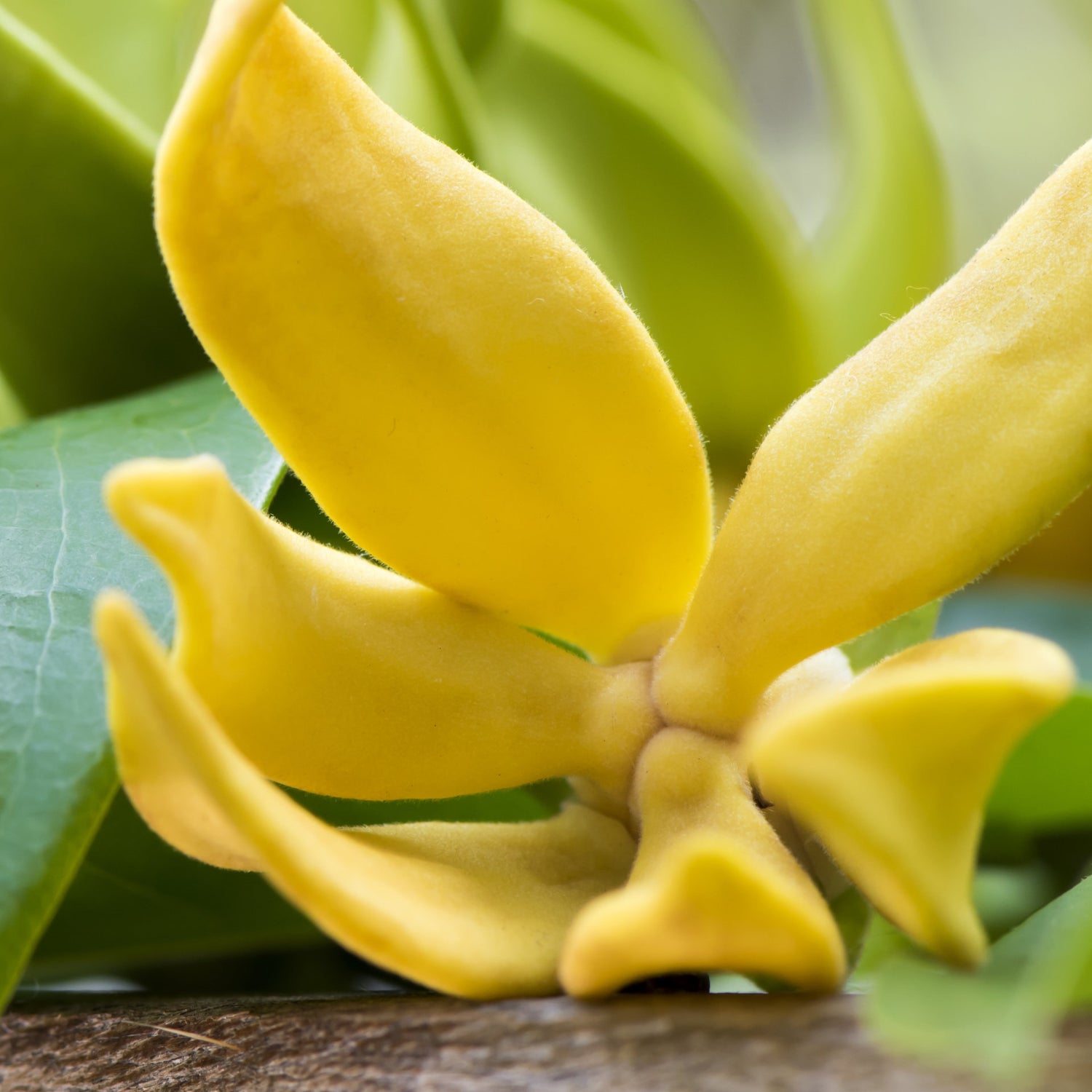
The Ylang-Ylang Tree
The Ylang-Ylang tree is found in humid tropical areas.
Native to India, Indonesia, Malaysia, and the Philippines.
Today, it is found on most tropical Pacific islands (Hawaii, Melanesia…), in the Indian Ocean, the Caribbean, Costa Rica, Thailand, and Vietnam.
In its native environment, this tree can reach 30 meters in height and has a very wide crown. In the first years, it can grow up to 5 meters per year. In cultivation, it is pruned to about 3 meters high.
Initially white, the petals gradually turn green then yellow. However, their base is red.
The Ylang-Ylang blooms throughout the year. However, it is more abundant during the hot and humid months.
Ylang-Ylang also produces fruit. Moreover, these fruits, 25 mm long, are formed by many green mericarps. When ripe, these mericarps turn black and contain berries.
The production of Ylang-Ylang
Since each Ylang-Ylang tree can provide 3 to 4 kg of flowers per harvest, Ylang-Ylang flower production is mainly located in the western islands of the southern Indian Ocean.
The Comoros is the largest producer in the world (with about 60 tons of essence per year). In second place is the State of Madagascar (which produces about 17 tons of essence per year). Next are Mayotte, the Philippines, and Mauritius.
The extraction of Ylang-Ylang essential oil
The extraction of Ylang-Ylang essential oil is a simple process suitable for both artisanal and industrial scales. However, it is an activity that requires expensive equipment and specific expertise.
There are three methods to extract Ylang-Ylang essential oil:
– extraction by hydrodistillation, which involves exposing Ylang-Ylang flowers to steam currents that carry all the ethereal and soluble substances and, after condensation, provide the essential oils and hydrosol
– extraction by solvent bath, which fixes the aromatic substances of the flowers. After these solvents have evaporated, a mixture of essence and compounds such as oil, pigments, wax… is obtained
– extraction by supercritical CO2, which only allows obtaining essential oils.
The most commonly used process today is hydrodistillation.
Depending on the professional’s equipment, several types of hydrodistillation are distinguished:
– open-flame hydrodistillation, the oldest method, which consists of heating the plant materials by an energy source located directly under the still;
– steam generator hydrodistillation;
– integrated boiler hydrodistillation;
– accelerated hydrodistillation;
– hydrodistillation with built-in condenser.